
CHRONIC PAIN PROJECT GOIB-PINEM23
Real-world evidence for every research line in chronic pain
From fragmented clinical practice to scalable evidence. One scientific standard, ten activatable clinical lines.
0% of clinical data is lost
Generated in routine practice, never analyzed
1 in 4 people
Lives with chronic pain worldwide
Over 20% experience anxiety or depression
Pain that lasts an average of more than 6 years, with repeated procedures and high use of healthcare resources
A unique project
OICP consensus for patient assessment and the development of therapeutic efficiency models. One of the most ambitious strategic RWE projects in chronic pain in Spain.
Project objectives
Measure what matters. Improve what matters.
Step by step
Scientific infrastructure already built, validated, and ready to scale.
Define the standard
Delphi consensus · 162 variables
Real-world infrastructure
eCRD and real-world data
Generate evidence — ongoing
Multicenter and international studies
Predictive intelligence
UAM-BSD Chair · Aponia
10 active research lines
All under the same framework study PINEM23-GOIB-OBS
Take part through the research line that best reflects your routine clinical practice and scientific interests
01
Rhizarthrosis
Intra-articular PRP + hyaluronic acid. Infiltrative strategy with the best results in real-world practice.
View projectBuilt together with clinical leaders and an active research network
The project combines expert consensus, clinical leadership, and scientific-academic support to generate real-world evidence in chronic pain.
+52 experts (Delphi)
Multidisciplinary consensus by specialty
Scientific and academic support
Institutions and collaborators backing the project
Activate your center and take part in the new standard
Join the general study or a priority subcohort.
Featured Scientific Publication From Consensus to Real-World Clinical Evidence
Our multicenter project has delivered its first scientific result: a national consensus defining the Optimal Information for Chronic Pain (OICP) — a standardized set of clinical variables to assess chronic pain patients in real-world clinical settings.
Title
Optimal Information for Chronic Pain (OICP): Delphi Consensus on Patient Assessment and Interventional Techniques
Journal of Pain Research (2025)
🔗 Read full article (DOI)Summary
This study, developed with the participation of more than 50 specialists across Spain, defines for the first time a minimum clinical dataset for chronic pain patients, covering three major domains: patient/pathology, treatment, and follow-up.
The consensus provides a common foundation for standardized data collection, inter-center comparison, and the development of Real-World Evidence (RWE) and artificial intelligence–based analysis models.
BioSmartData contributed to the technical deployment of the Delphi platform and the coordination of survey dissemination, without participating in study design, data analysis, interpretation of findings, or manuscript writing.
Co-funding and Acknowledgments: This project is co-funded by the European Regional Development Fund (ERDF/FEDER) and the Sustainable Tourism Tax of the Balearic Islands (ITS). “A way to make Europe.” Duration: 2023–2025 Reference: GOIB-PINEM23 · PINEM23_019 Beneficiary Entity: BioSmartData S.L.
PRP & Tendon Project
Join the world’s largest real-world PRP & Tendon study.
Be part of an international, multicenter, scientifically-driven project to transform clinical practice into solid evidence.
Over 3,000 patients
100+ international centers
Be part of the solution
RWE PRP & Tendinopathies
International RWE study. The scientific infrastructure that turns real-world PRP clinical practice into comparable evidence — the Real-World Evidence solution powering the next generation of clinical care.
0%
of clinical data never becomes useful knowledge. It is unstructured, disconnected, fragmented, non-interoperable — medicine treats, the system does not learn.
Nature Medicine — The next generation of evidence-based medicine
Modern medicine generates an ocean of data
But most of it goes unused: it is…
Real-world clinical practice holds the evidence the system still cannot read.
Without connected data, prediction, personalization and progress are impossible.
Real World Evidence + Data Intelligence
Turns real clinical practice into useful evidence
Multiple sites, one shared clinical question
Links clinical variables to uncover patterns and predict responses
Principal Investigator
Dr. Ferrán Abat
Sports traumatologist and biologic therapies specialist
Ethics approval
CER-FCSB No. 2025-12-06
Registry
RWE-TDP-20251206
Study
The largest multicenter study of PRP in tendinopathies
ClinicalTrials.gov
Shaped by a real need.
01
Research
Capture the critical PRP variables in a structured way
02
Clinical
What works, when, for whom, and in what clinical context
03
Regulatory
New SoHO framework, effective August 2027 — stricter traceability requirements
Generating evidence from clinical practice
Product
PRP: high adoption, low standardization
Gap
Lack of comparable evidence
Opportunity
ORBIT-ESSKA 2022 consensus
Response
The largest study in tendon pathology
Value
A foundation for clinical standardization
4 projects + 2 subcohorts
PRP in tendinopathies by location and by sport
Join through the research line that best reflects your everyday clinical practice and scientific interests
03
Patellar tendinopathy
View project →
04
Epicondyle
View project →
05
Achilles
View project →
06
Plantar fasciitis
View project →
Multicenter, multidisciplinary, international
Seven specialties under one shared study framework
Scientific-operational structure
Coordinating investigator
Sponsor · ReSport Clinic
Approval · Blanquerna
Approval · SETRADE
Technology provider · BSD
Scientific committee
Dr. Sánchez · Dr. Jordi Puigdellivol · Dr. Paul Terán · Dr. Hernán Giuria · Dr. Franco de Vedoba · Dr. Gil Rodas · Dr. Severiano dos Anjos · Sra. Maria Cayuela
How to get started?
Schedule a meeting → review the protocol → sign and access the platform. Deadline: June 27.
Setrade PROJECT
GENERAL OVERVIEw
In collaboration with SETRADE (Spanish Society of Traumatology and Sports), a multicenter study is developed to evaluate the efficacy and safety of PRP in osteochondral knee, hip, and ankle injuries. The PRPData platform ensures real-world clinical data collection and analysis.
MAIN Objective
Analyze PRP efficacy, safety, and composition in osteochondral injuries through a prospective observational multicenter pilot study.
secondary Objective
Evaluate PRP protocols, relate composition to outcomes, identify best practices, improve data collection.
phases
Initial data collection
Treatment and follow-up
Analysis
Publication
Lead Investigator
Dr. Ramón Cugat, Dr. Mikel Sánchez, Juan Diego Ayala Mejías, Pedro Bernáldez, Dr. Rafael Arriaza, Javier Iglesias, Jordi Puigdellívol.
Associated Centers
Hospital Quirónsalud Barcelona, Unidad de Cirugía Artroscópica, Hospital San Rafael Madrid, and other centers. Project endorsed by SETRADE.
Technology behind
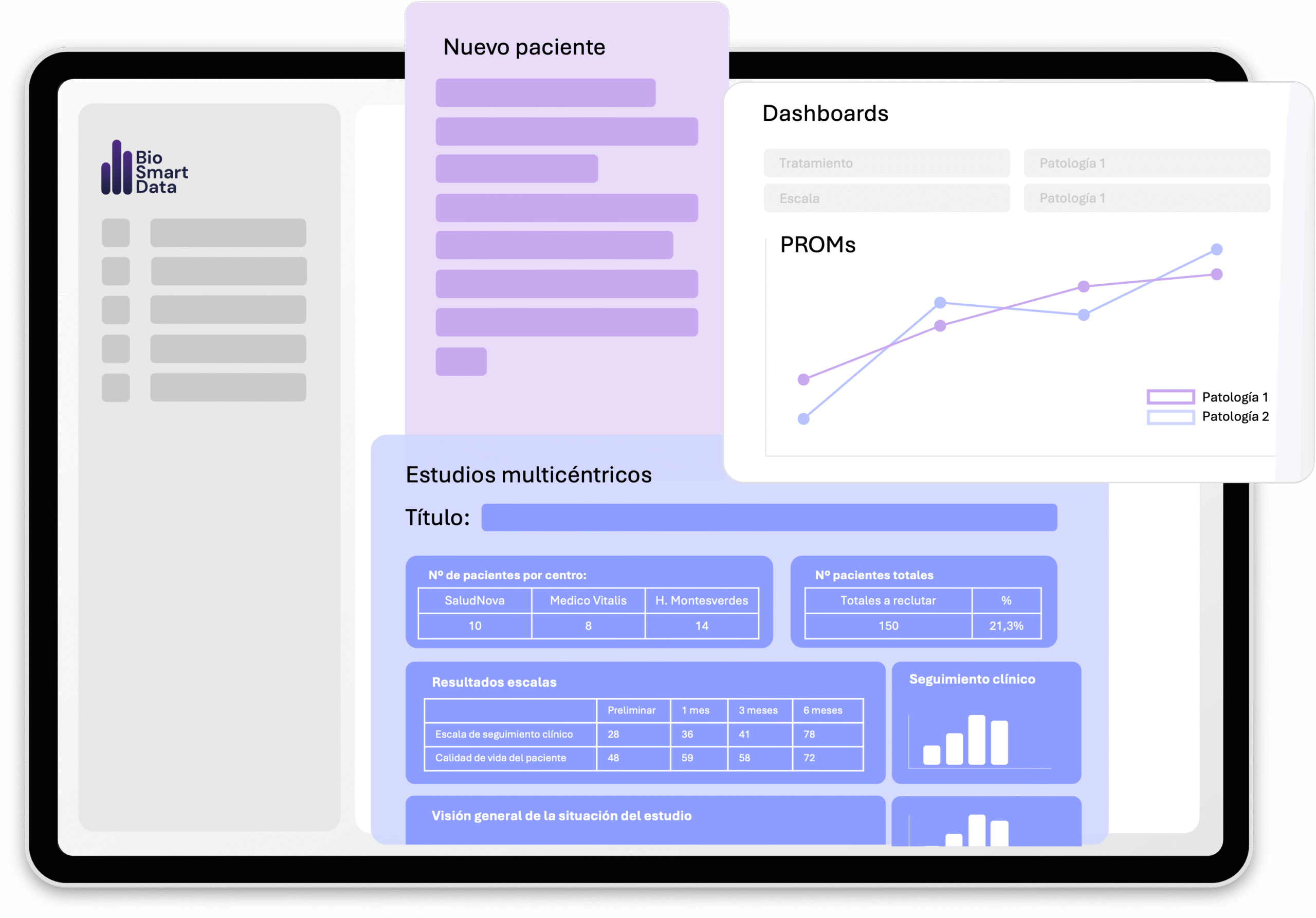
Powered by BioSmartData Technology: Fully digital eCRD, direct connection with hematology analyzers, data encryption and GDPR compliance, AI analysis to identify predictive clinical variables.
Simple process
Patient → PRP Extraction → Digital Data Entry → Secure Analytics → Scientific Outcomes
The Technology behind
Powered by Biosmart data technology
- Fully digital eCRD powered by BioSmartData®
- Direct connection to hematology analyzers for PRP classification
- Data encryption, GDPR-compliance & ENS security levels
- AI-powered analysis to identify predictive clinical variables after the study
FAQs
Who can participate?
Any clinical center, hospital or private practice with experience in PRP (Platelet-Rich Plasma) treatments applied to tendon pathologies (patellar, Achilles, epicondylitis, plantar fasciitis). Both public and private institutions are welcome.
What is the cost to participate?
Participation in the study itself is free of charge. Centers only assume the costs associated with acquiring the technology required to operate:
- The BioSmartData® software license
- A compatible hematology analyzer for PRP characterization.
What technology do I need to participate?
- A valid BioSmartData® Software license (cloud-based, easy installation).
- A hematology analyzer capable of PRP parameter analysis (platelet count, WBC, RBC, volume, etc.), compatible with the BioSmartData® system.
- Internet connection to access the platform securely.
How long is the follow-up period for each patient?
Each patient will be monitored for a minimum of 12 months following their PRP treatment, allowing us to collect both short- and mid-term clinical outcomes.
What type of data is collected?
The platform captures structured clinical data directly from your routine practice, including:
- Patient demographics (fully anonymized)
- Clinical diagnosis and tendinopathy location
- PRP preparation parameters and hematology results
- Treatment protocols used
- Functional outcome measures and clinical scales
- Follow-up assessments at predefined timepoints
Who owns the data?
All data is fully anonymized and managed under strict ethical standards. The study database is a collective scientific repository governed by the international research consortium and scientific committee.
Each participating center maintains access to its own cases, and global aggregated data will be used for joint scientific publications.
How is patient data protected?
Patient privacy and data security are top priorities. The platform ensures:
- Full data anonymization
- AES-256 encryption protocols
- GDPR compliance (Europe)
- ENS High Level Security (Spain)
- Controlled access only for authorized research staff